AI can write your mission statement before your coffee gets cold. It can give you 30 taglines, six audience personas, a brand voice guide and a homepage that says you are bold, authentic, innovative and human-centred. Very efficient. Also, somehow, the exact same brand as everyone else.
I use AI constantly. I also built this entire website by co-working with AI. I am clearly not here to clutch my pearls and demand that everybody return to typewriters.
My answer is simple: use AI for branding. Use it generously. Let it make the work faster, leaner and less expensive. Keep the thinking, taste and final judgment firmly in human hands.
“AI can create the scene. Someone with taste still has to direct the movie you are making.” — Geetika Khurana
What AI Can Do Well in Branding
AI is excellent at speed, scale and pattern recognition. It can organize messy interview notes, summarize recurring themes in customer feedback, generate rough options, compare competitor language, pressure-test an idea and turn one approved message into multiple formats, design your collaterals faster thank you can blink, create jaw-dropping websites with imagery so real – you’ll begin to doubt your own judgement – was this really shot or is it CGI?
That is real value. Qualtrics’ guide to AI in brand research highlights useful applications such as analyzing customer feedback, identifying patterns, segmenting audiences and testing messages at scale. Those jobs used to consume days. AI can move through parts of them in hours.
Efficiency becomes a problem only when it gets mistaken for direction. Producing more words does not mean you found the right thing to say.
Where AI-Generated Branding Starts to Sound the Same
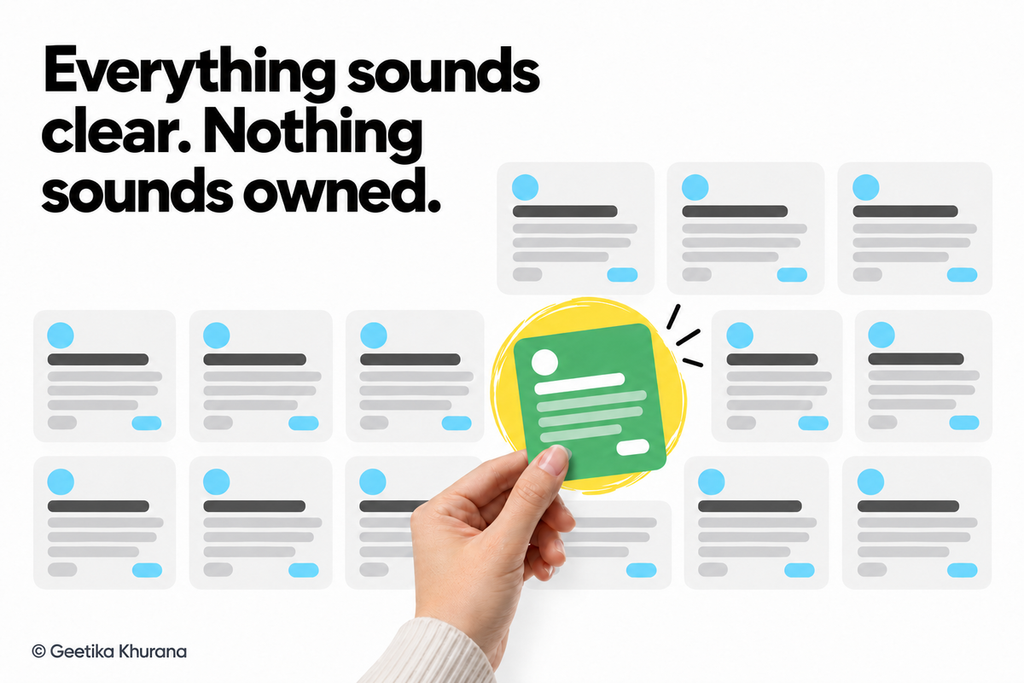
Now multiply that across thousands of founders and marketing teams, all under pressure, all asking similar tools for a LinkedIn post, a brand purpose, a launch hook or a new way to say customer-centric. The output becomes polished wallpaper.
There is research behind that feeling. A 2024 study published in Science Advances found that writers with access to generative AI ideas produced stories rated as more creative and enjoyable, while the AI-assisted stories were also more similar to one another. AI lifted individual output and narrowed collective novelty at the same time.
That is AI slop in a nicer outfit: content that is technically competent, immediately recognizable and emotionally vacant. You can usually spot it by the smooth voice, the predictable rhythm and the heroic quantity of words saying almost nothing.
Everything sounds clear. But nothing sounds owned. Nothing sounds like it’s truly yours.
AI Is the Actor. Your Brand Expert Is the Director
“Think of AI as a brilliant actor who can perform in 40 styles, work at impossible speed and never complain about another take. A founder is producing the film. The brand expert is the director.”
Geetika Khurana
Taste is the ability to look at ten perfectly acceptable options and know that nine of them should never leave the group chat. Judgment is knowing which truth matters enough to build the brand around. Context is hearing a founder make one throwaway comment in a meeting and realizing that the throwaway comment contains the entire company.
AI can analyze what has already been said. A good brand expert can feel when the category is exhausted, when the obvious answer is too obvious, when a message is technically accurate but strategically useless, and when one slightly dangerous idea has the spark the brand needs.
I’ve been pursuing stand-up comedy and it has made this even clearer to me. You can analyze a joke’s setup, structure and punchline. On stage, one word, one pause or one look can hold the laugh. Capturing the essence of the joke takes instinct, timing and a live understanding of people. Brand work lives in that same territory. The technically correct sentence can still die in the room.
A director decides what the scene is really about, what emotional note it must hit and what gets cut even when it is good. Brand direction does the same job. It identifies the customer tension worth owning, the point of view competitors cannot credibly copy and the tone people should recognize without seeing the logo.
AI Titles Versus a Human Title With Taste
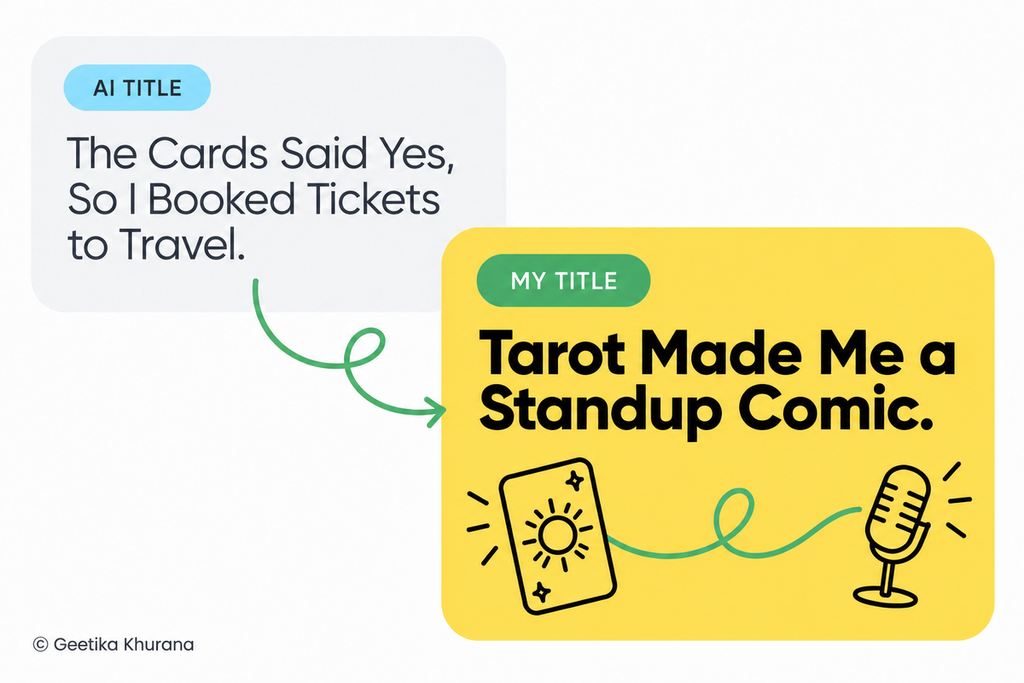
I saw this difference while naming a personal essay about the strange route that took me from a tarot reading in Mumbai to performing stand-up comedy in Toronto. AI gave me titles that tried to explain the whole plot. One was essentially:
“The Cards Said Yes, So I Booked Tickets to Travel.”
There were other versions in the same family: polished, descriptive and trying very hard to make sure nobody missed the point. They sounded like titles created by a machine that had been asked to summarize the essay before anyone clicked it.
My options were:
“Tarot Led Me to a Standup Stage.”
“Tarot Made Me a Standup Comic.”
The second is my pick. Six words. Two worlds that do not normally sit together. Enough information to understand the premise and enough missing to make you want the story.
AI had access to the facts. But taste decides the tension between tarot and stand-up was the hook. The best title is not explaining more. It’s choosing the right hook to rev up interest.
How I Built My Website With AI Without Letting It Build My Brand
I created geetikakhurana.com by co-working with AI. It helped me think through page structures, generate versions, tighten language, build and revise. The process became faster than it would have been with a traditional website production setup.
I did not ask AI to decide who I was, what I should sell or what deserved to lead. I directed the positioning, the layout designs, my own style of imaergy, color palette, brand signature elements, chose the offers, set the hierarchy, rejected language that sounded like everybody else and kept pushing until the website sounded like me.
I was not asking AI who I was. I was telling it what I was building.
That distinction shaped the result. AI gave me an extraordinary range of capability. Direction turned that capability into one coherent brand.
You can see the same principle in my one-line brand pitch test: the hard part is deciding who the brand is for, what value matters and what makes it meaningfully different. Faster copy cannot rescue an unresolved position.
Prompting is part of execution. Direction decides what the prompts are trying to create.
A Practical AI Branding Workflow for Lean Teams
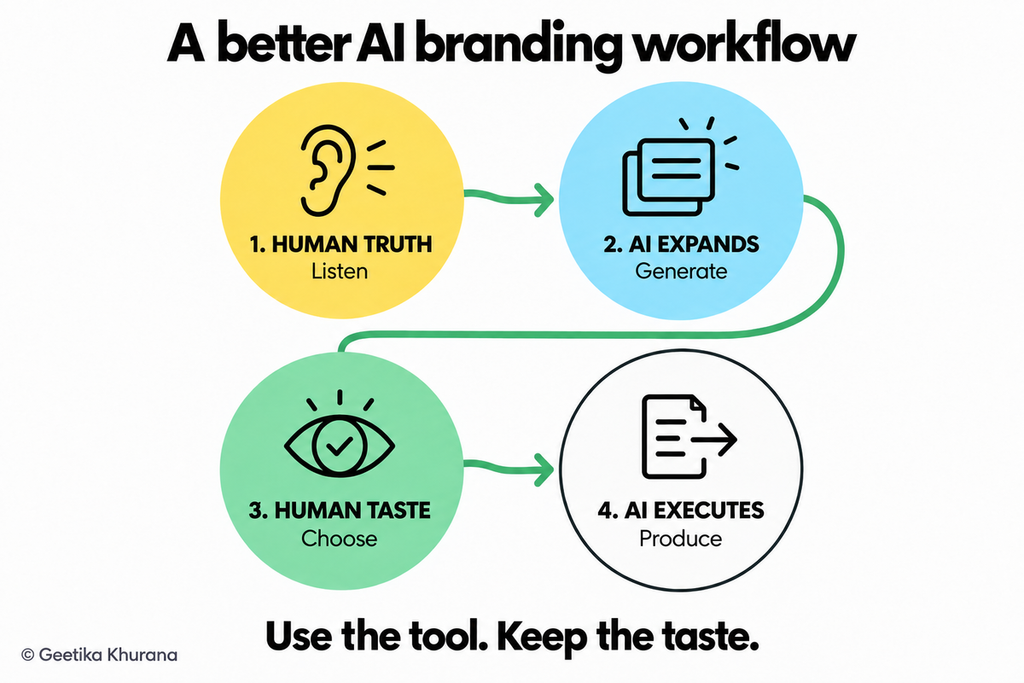
Start With Human Truth
Talk to customers. Listen to the founder. Study the product, the category, the business model and the ambition. Find the tension or belief the brand can genuinely own. Do this before asking a tool for taglines.
Use AI to Expand and Organize
Let AI cluster research, find repeated language, generate territories, surface counterarguments and create many rough options. Check facts and protect confidential information according to the tool and account you use.
Apply Taste Before Choosing
Evaluate every option against the position. Remove anything generic, borrowed, over-polished or emotionally false. The first plausible answer is rarely the sharpest one.
Use AI Again After the Direction Is Clear
Once the strategy, voice and creative standard are set, AI becomes far more useful. It can create variants, repurpose approved ideas, support production and help a lean team stay consistent without flattening the brand.
Lean Budgets Should Still Invest in Direction
AI lets businesses operate with smaller teams, faster timelines and lower production costs. That makes highly talented people more valuable, not less. A lean team works when the talent density is high and somebody experienced owns the decisions.
Geetika Khurana
If your budget cannot support a full agency or an in-house brand team, buy the thinking in a focused way. Bring in a consultant for a positioning sprint, a brand audit, the core messaging for a few senior hours each month. Then use AI and a small team to execute the direction.
AI has made mediocre output very cheap. Taste, talent and human insight are now where the advantage lives.
And if you need a brand consultant who uses AI, argues with it, deletes half of what it says and keeps the useful parts, I know a good one. See my brand consulting services.
FAQs
Can AI create a brand strategy?
AI can assist with brand research, synthesis, ideation and first drafts. A strong brand strategy still requires choices about audience, positioning, differentiation, emotional relevance and business priorities. AI can support those decisions; an experienced human should own them.
Can AI replace a brand consultant?
AI can replace parts of the workload a brand consultant once handled manually. It does not reliably replace taste, judgment, facilitation, founder insight or the ability to choose a distinctive strategic direction when several options look reasonable.
How should a small business use AI for branding?
Use AI to organize research, generate rough options, test objections, adapt approved messaging and repurpose content. Set the positioning and voice first so the tool has a real brand to work from.
Is AI-generated content bad for SEO?
AI-assisted content is not automatically bad for SEO. Google’s guidance on generative AI content focuses on originality, usefulness and value to readers. Publishing large volumes of unoriginal content created mainly to manipulate rankings can violate its spam policies. Human expertise and a distinct point of view make the content worth finding in the first place.